One thing I learned from inclusionary zoning is that the development community doesn't all think alike. In fact, often, two people from the same company often don't even think alike. Toss in the alders advocating for the developers, and is all gets . . . just twisted. Consider the opposing viewpoints I heard in less than 2 hours yesterday . . .
Density
Incentives have to be automatic, including density bonuses, because that's what makes the project work.
AND
Density bonuses have no value.
AND
Other places give a 25% density bonus. (Implying we should give a higher density bonus)
So, do density bonuses have value or not? hmmmm . . . . Me thinks they do.
Incentives have to be administrative
These should not be political decisions.
AND
If the developer doesn't like what the staff decides about the incentives, they can appeal to the plan commission.
Hmmmm . . . not a political decision . . . unless it benefits the developer.
Incentives have to be automatic
The incentives have to be given if they are requested, they should be guaranteed.
AND
If there is no money to give out, the city shouldn't adjust its budget accordingly.
Ok - this one is kind of funny. And this one does get credited to an alder. They think that neighborhoods should accept the density no matter what. But the city shouldn't provide any taxpayer dollars to support the program if the fund runs dry.
Waivers and Cost off-setting
The value of the incentives have to off-set the costs of the developer to create the affordable housing.
AND
It's too difficult to provide the staff the information about costs to get a waiver at the time the project is getting land use approvals because the project isn't far enough along.
OK - this is intriguing. They don't want to provide the information for the waiver because it isn't reliable, but . . . and someone actually said this . . . "we should just trust the developers" to provide us the information about what it costs to create the affordable housing. Hmmm . . . they admit they don't have accurate information, but on the other hand, we should just trust them.
Staff
Everything should be automatic and administrative.
AND
We aren't going to add any staff.
Right, cuz they can just do more with less. Obviously the person who said this hasn't been waiting for anything from the Department of Planning and Development for months. Oh, wait, where is that Housing Affordability Reduction Plan?
Other comments:
When the original ordinance was passed I met several times with several developers. I repeatedly asked a specific group of downtown developers what incentives would work for them. They gave me nothing - except that they wanted cash, which as we established, alders are clearly resistant to providing. One of those developers that sat through those multiple meetings launched into an impassioned speech about how we (and he was staring right at me or the mayor) don't want the incentives to mean anything. This was preceded earlier in the meeting by the lobbyists for the Realtors and Smart Growth Madison insisting that we keep the incentives and pointing out how many other ordinances had incentives. I'm not sure where this all came from, unless they were reacting to Larry wanting to take out all of the incentives except density or if something else happened at the last meeting.
At first, I was just pissed, as that group of developers was not very helpful in trying to solve problems on inclusionary zoning and I couldn't believe he had the audacity to sit there and yell (yes, he was nearly yelling) about us being "insincere". Then, I just wanted to laugh. Duh, the incentives are what make this ordinance legal (avoid a lawsuit over takings), of course we not only want them, we want them to work to keep the ordinance legal.
OK - I could go on, but risk getting snarkier and snarkier . . . my next post will be a more thoughtful response to some of the goals for the incentives and possible incentives I have heard.
Read more!
Wednesday, March 29, 2006


Inclusionary Zoning - Twists, spins and goes in circles
And we end up nearly where we started?
WARNING: Talking about equity models is boring. If you don't want to hear alot of wonk talk about equity models, just stop reading now. But trust me, this new solution makes it very simple.
After 6 meetings of the mayor's IZ workgroup, we finally got to the point where we have two options for equity models.
The one favored the most, but just barely, would work as follows:
When the home is sold to the buyer, the difference between the Market Value price of the home and the IZ price of the home is x% or the city's share of the investment in the home. The buyer at that point is investing the remaining percent of the home value or 100% - x%. When the homeowner sells the home, they take 5% of the new market value of the home for any improvements made to the home. Then, the city gets the x% of the market value based on the initial calculations - 5% for improvement. The seller gets the remaining portion.
The math works out this way . . . (there is no magic to why I used these numbers, except ease of math.)
Original Sale
Market value = $200,000
IZ value = $180,000
(city % is 10%, the buyer % is 90%)
Sale by homeowner
Market value = $400,000
subtract 5% ($20,000) for the improvements to the home = $380,000
City gets 10% of the remaining portion or $38,000 to invest back into the home to keep it affordable for the next buyer, the seller gets $342,000 (90% of [market value - 5%]) + $20,000 (5% of market value) or $362,000.
Simple. No receipts to prove the amount of the improvements, no digging through assessors records, no fluxuating % of city vs. owner equity, no assessment area calculations, no complicated spreadsheets, etc. etc. etc.
Next up . . . incentives! Read more!
WARNING: Talking about equity models is boring. If you don't want to hear alot of wonk talk about equity models, just stop reading now. But trust me, this new solution makes it very simple.
After 6 meetings of the mayor's IZ workgroup, we finally got to the point where we have two options for equity models.
The one favored the most, but just barely, would work as follows:
When the home is sold to the buyer, the difference between the Market Value price of the home and the IZ price of the home is x% or the city's share of the investment in the home. The buyer at that point is investing the remaining percent of the home value or 100% - x%. When the homeowner sells the home, they take 5% of the new market value of the home for any improvements made to the home. Then, the city gets the x% of the market value based on the initial calculations - 5% for improvement. The seller gets the remaining portion.
The math works out this way . . . (there is no magic to why I used these numbers, except ease of math.)
Original Sale
Market value = $200,000
IZ value = $180,000
(city % is 10%, the buyer % is 90%)
Sale by homeowner
Market value = $400,000
subtract 5% ($20,000) for the improvements to the home = $380,000
City gets 10% of the remaining portion or $38,000 to invest back into the home to keep it affordable for the next buyer, the seller gets $342,000 (90% of [market value - 5%]) + $20,000 (5% of market value) or $362,000.
Simple. No receipts to prove the amount of the improvements, no digging through assessors records, no fluxuating % of city vs. owner equity, no assessment area calculations, no complicated spreadsheets, etc. etc. etc.
Next up . . . incentives! Read more!
Tuesday, March 28, 2006
And you thought I gave lobbyists a bad name . . .
Sometimes, they do it themselves! Consider the misleading statements made by Attorney Ron Trachtenberg in a recent letter to the City of Madison Mayor and Alders:
We are the attorneys for Stefan Varo who holds an accepted non-contingent offer to purchase (as Buyer) on 2317, 2345 and 2409 Allied Drive from the Receiver in Dane County Circuit Court Case No. 06 CV 357 as Seller. That sale is subject to the approval of the court, which is the subject matter of the court hearing on April 18, 2006. (Please note that contrary to the statements within the above referenced resolution, there is no auction scheduled on April 18, 2006, only the issue of whether the court should approve the actual sale to Mr. Varo.)To which the receiver of the Hauk Investments, LLC replied:
First, Mr. Trachtenberg indicated that there is no auction scheduled for the sale of the Hauk Investments project. That is not the case. In fact, all potential buyers, including Mr. Stefan Varo, have been repeatedly advised that it is the Receiver's duty to obtain competitive bids for the property. For example, I have enclosed a copy of my correspondence to Attorney Vern Jesse of the Murphy Desmond firm dated March 15, 2006 which confirms that we anticipate competitive bidding at the hearing to approve the sale of the project.Sheesh . . . would you hire this guy?! Read more!
Mr. Trachtenberg also indicates in his correspondence that the only issue at the April 18, 2006 hearing is whether the Court should approve the actual sale to Mr. Varo. That is also not the case. In fact, I have not even filed a Motion to approve the proposed sale of the Hauk Investments project at this point.
Finally, Mr. Trachtenberg's letter indicates that the proposed sale to Mr. Varo is "non-contingent". In fact, the sale is contingent upon approval by the Dane County Circuit Court. In addition, the receiver has expressly agreed that his acceptance of the Varo offer can be withdrawn if a higher offer for the property is received.
Monday, March 27, 2006
Who wants to reduce the density and height of the project?
Conventional wisdom says: the neighborhood.
My experiences of the last week says: the developer.
Yup, twice in one week two major developments in the 2nd district have reduced the height and the density of their projects - not because of the neighborhood, but because of the developer! And I've had neighbors asking questions like . . . "can you add back some of the height?" . . . and, saying things like "we liked the 10 story building!"
"What's going on?" you might ask. Seems as tho conventional wisdom has been turned on its head. However, the explanation is pretty simple, and consistent. The cost of the type of construction is limiting the projects, building with wood is cheaper than cast conrete and steel. In both cases, the tallest buildings/portion of buildings are now 5 stories which is the breaking point for using more expensive materials.
The Gorman project on the 800 block of E Washington had the most dramatic reduction in both height and density. The original project had one 10-story building, five 5-story buildings and three 3-story buildings and had 309 residential units. Now it has three 5-story buildings and sixteen 3-story buildings and only 176 residential units. The project maintains the 13,000 square feet of retail and loses the community space. As a result, the TIF request is now less than half of the original projected request.
The Great Dane Development project at 627 E Mifflin took two stories off the highest portion of the building. It had 80 units in a building that had heights of 3, 5 and 7 stories. Tonight, the developers told us that the 7 story portion of the building would be reduced to 5 stories and there would only be 66(?) units. Some of the units from the top floors were moved to the bottom level and replace some of the parking. These developers are not asking for TIF for this project.
Interesting turn of events. The developer mantra of "we need more height/density to make the project work in the downtown area" has been turned on its head.
p.s. This would be a good time to remind folks the height does not equal density. Tall buildings with small footprints and large units can be the same density as shorter buildings, with larger footprints and smaller units.
Read more!
My experiences of the last week says: the developer.
Yup, twice in one week two major developments in the 2nd district have reduced the height and the density of their projects - not because of the neighborhood, but because of the developer! And I've had neighbors asking questions like . . . "can you add back some of the height?" . . . and, saying things like "we liked the 10 story building!"
"What's going on?" you might ask. Seems as tho conventional wisdom has been turned on its head. However, the explanation is pretty simple, and consistent. The cost of the type of construction is limiting the projects, building with wood is cheaper than cast conrete and steel. In both cases, the tallest buildings/portion of buildings are now 5 stories which is the breaking point for using more expensive materials.
The Gorman project on the 800 block of E Washington had the most dramatic reduction in both height and density. The original project had one 10-story building, five 5-story buildings and three 3-story buildings and had 309 residential units. Now it has three 5-story buildings and sixteen 3-story buildings and only 176 residential units. The project maintains the 13,000 square feet of retail and loses the community space. As a result, the TIF request is now less than half of the original projected request.
The Great Dane Development project at 627 E Mifflin took two stories off the highest portion of the building. It had 80 units in a building that had heights of 3, 5 and 7 stories. Tonight, the developers told us that the 7 story portion of the building would be reduced to 5 stories and there would only be 66(?) units. Some of the units from the top floors were moved to the bottom level and replace some of the parking. These developers are not asking for TIF for this project.
Interesting turn of events. The developer mantra of "we need more height/density to make the project work in the downtown area" has been turned on its head.
p.s. This would be a good time to remind folks the height does not equal density. Tall buildings with small footprints and large units can be the same density as shorter buildings, with larger footprints and smaller units.
Read more!
Sunday, March 26, 2006
Best bang for the (TIF) buck!
This morning's WSJ article on TIF got me thinking . . . about something we did alot of thinking about months ago.
If you had to make decisions about the limited amount of TIF dollars in the City of Madison, how would you spend them? What would you base your decisions on? Would it be the impact of the change that a project can bring to a neighborhood? How would you measure the community benefits of these projects? Would you prioritize the "generator" project for the district? (i.e. a large project that would start creating tax dollars to repay the TIF district) Would you consider what would happen if the projects don't go forward or what other public projects won't have money to be completed. (i.e. what happens to things like the mayor's promises of money to move rail lines?) Would you look at the value created by the projects? What else should we be looking at when we make these decisions beyond the bottom line to the taxpayer? Jobs? Retail opportunities? Housing?
Consider the following projects:
Mortensen Investments/Landmark Place
Wants $4.2M - The City will get taxes on a $20M project (Taxpayers help with 21% of the projected value generated)
Gorman/800 E Washington Ave
Wants approximately $3.8M - The City will get taxes on $58M (Taxpayers help with 6.5% of the projected value generated)
Original request would have been $7M on an $84M project (Taxpayers help with 8% of the projected value generated)
McGrath/Union Corners
Wants $6.2M - The City will get taxes on $55.9M first phase project (Taxpayers help with 11% of the projected value generated)
McGrath/First Street project - no info yet
University Square/Executive Management
Wants $7-10M - The City will get taxes on $44.4M portion of the project (Taxpayers help with 16 to 22% of the projected value generated)
Allied Drive
Up to $5.8M - on a $??M project
BioAg Gateway
$2-3M - on $??M project
Kipp
$2.5 to $6.7M on a $??M project
Projects approved in the last year
Monroe Commons
$2.3M for $22.9M project (Taxpayers helped with 10% of the projected value generated)
Randy Alexander/Capital West
$4.27M for the $47.2M project (Taxpayers helped with 9% of the projected value generated)
Covance
$4.6M for $50M project (Taxpayers helped with 9% of the projected value generated)
Gorman on Allied/Avalon Village
In this case the City bought for the land for $3.5M and sold it for $1.56M or assisted the project with approximately $2M for the $13.1M project. (Taxpayers helped with 15% of the projected value generated)
How much money should we be borrowing for TIF? Which projects do you think would be the best use of taxpayer dollars? And whatever happened to the discussion on changes to the City of Madison TIF policy discussed nearly a year ago?
Obviously, since I sat on the subcommittee of the Board of Estimates and worked with Progressive Dane, I agree with much of what is in those proposals. I think we would be making better decisions if we would have resolved these big policy issues prior to these projects coming forward. Read more!
If you had to make decisions about the limited amount of TIF dollars in the City of Madison, how would you spend them? What would you base your decisions on? Would it be the impact of the change that a project can bring to a neighborhood? How would you measure the community benefits of these projects? Would you prioritize the "generator" project for the district? (i.e. a large project that would start creating tax dollars to repay the TIF district) Would you consider what would happen if the projects don't go forward or what other public projects won't have money to be completed. (i.e. what happens to things like the mayor's promises of money to move rail lines?) Would you look at the value created by the projects? What else should we be looking at when we make these decisions beyond the bottom line to the taxpayer? Jobs? Retail opportunities? Housing?
Consider the following projects:
Mortensen Investments/Landmark Place
Wants $4.2M - The City will get taxes on a $20M project (Taxpayers help with 21% of the projected value generated)
Gorman/800 E Washington Ave
Wants approximately $3.8M - The City will get taxes on $58M (Taxpayers help with 6.5% of the projected value generated)
Original request would have been $7M on an $84M project (Taxpayers help with 8% of the projected value generated)
McGrath/Union Corners
Wants $6.2M - The City will get taxes on $55.9M first phase project (Taxpayers help with 11% of the projected value generated)
McGrath/First Street project - no info yet
University Square/Executive Management
Wants $7-10M - The City will get taxes on $44.4M portion of the project (Taxpayers help with 16 to 22% of the projected value generated)
Allied Drive
Up to $5.8M - on a $??M project
BioAg Gateway
$2-3M - on $??M project
Kipp
$2.5 to $6.7M on a $??M project
Projects approved in the last year
Monroe Commons
$2.3M for $22.9M project (Taxpayers helped with 10% of the projected value generated)
Randy Alexander/Capital West
$4.27M for the $47.2M project (Taxpayers helped with 9% of the projected value generated)
Covance
$4.6M for $50M project (Taxpayers helped with 9% of the projected value generated)
Gorman on Allied/Avalon Village
In this case the City bought for the land for $3.5M and sold it for $1.56M or assisted the project with approximately $2M for the $13.1M project. (Taxpayers helped with 15% of the projected value generated)
How much money should we be borrowing for TIF? Which projects do you think would be the best use of taxpayer dollars? And whatever happened to the discussion on changes to the City of Madison TIF policy discussed nearly a year ago?
Obviously, since I sat on the subcommittee of the Board of Estimates and worked with Progressive Dane, I agree with much of what is in those proposals. I think we would be making better decisions if we would have resolved these big policy issues prior to these projects coming forward. Read more!
Tuesday, March 21, 2006
Scratchiti has it all . . . .
Rarely, have I seen:
a) such a colossal brazen attempt to get media attention
b) over a "feel-good",
c) "solution-in-search-of-a-problem" ordinance
d) that has "unintended consequences",
e) has "no data" to back it up and
f) is a "waste of taxpayer dollars".
What am I talking about? Alder Brandon's much heralded (by him) "scratchiti" ordinance.
Anyone want to guess how many graffiti tickets have been written according to the Municipal court report from 1/04 - 3/06?
Anyone want to guess how many graffiti tickets the Assistant City Attorneys can remember being prosecuted?
Anyone want to guess how many tickets the Municipal Judge Dan Koval can remember being prosecuted?
None. Zip. Nada.
Ok - so I agree with Alder Brandon, scratchiti is a problem. I did some research based on the last year of Police District Newsletters. In the Central Police district, there were 91 reported graffiti incidents and 7 of them were scratchiti. I checked the East Police District newsletter and there were 36 graffiti incidents, but all involved paint and markers. West Police district didn't provide information on Graffiti. (I ran out of time to look at South and North.)
I also got some other numbers from the police department that indicated that graffiti reports are on the rise. Seems as tho either
a) we are doing a better job reporting,
b) the police department is doing a better job of capturing the information, or . . .
c) we have a graffiti outbreak . . .
2002 =227
2003 =208
2004 =160
2005 =504
So, graffiti is a problem. Scratchiti is probably a small issue relatively speaking considering everything else the police deal with, but we already have ordinances and laws in place to address the issue.
Worse yet, this has the possibility of having the reverse of the desired effect. Currently, scratchiti is covered by other ordinances and state laws currently in place. Additionally, it is likely referred to the D.A.s office for prosecution if it is particularly bad. (Criminal damage to or graffiti on religious and other property 943.012 or Graffiti-943.017) If we allow this fine, some police officers may use their discretion and simply give a ticket instead of referring to the D.A.s office, resulting in a lesser punishment to the vandals. So, it seems to have the opposite of the "get tough on crime" effect the good alder was seeking.
p.s. Thanks to City Attorney Michael May, Assistant City Attorney Marci Paulsen and Police Chief Noble Wray for getting me the info in the last day or so. Read more!
a) such a colossal brazen attempt to get media attention
b) over a "feel-good",
c) "solution-in-search-of-a-problem" ordinance
d) that has "unintended consequences",
e) has "no data" to back it up and
f) is a "waste of taxpayer dollars".
What am I talking about? Alder Brandon's much heralded (by him) "scratchiti" ordinance.
Anyone want to guess how many graffiti tickets have been written according to the Municipal court report from 1/04 - 3/06?
Anyone want to guess how many graffiti tickets the Assistant City Attorneys can remember being prosecuted?
Anyone want to guess how many tickets the Municipal Judge Dan Koval can remember being prosecuted?
None. Zip. Nada.
Ok - so I agree with Alder Brandon, scratchiti is a problem. I did some research based on the last year of Police District Newsletters. In the Central Police district, there were 91 reported graffiti incidents and 7 of them were scratchiti. I checked the East Police District newsletter and there were 36 graffiti incidents, but all involved paint and markers. West Police district didn't provide information on Graffiti. (I ran out of time to look at South and North.)
I also got some other numbers from the police department that indicated that graffiti reports are on the rise. Seems as tho either
a) we are doing a better job reporting,
b) the police department is doing a better job of capturing the information, or . . .
c) we have a graffiti outbreak . . .
2002 =227
2003 =208
2004 =160
2005 =504
So, graffiti is a problem. Scratchiti is probably a small issue relatively speaking considering everything else the police deal with, but we already have ordinances and laws in place to address the issue.
Worse yet, this has the possibility of having the reverse of the desired effect. Currently, scratchiti is covered by other ordinances and state laws currently in place. Additionally, it is likely referred to the D.A.s office for prosecution if it is particularly bad. (Criminal damage to or graffiti on religious and other property 943.012 or Graffiti-943.017) If we allow this fine, some police officers may use their discretion and simply give a ticket instead of referring to the D.A.s office, resulting in a lesser punishment to the vandals. So, it seems to have the opposite of the "get tough on crime" effect the good alder was seeking.
p.s. Thanks to City Attorney Michael May, Assistant City Attorney Marci Paulsen and Police Chief Noble Wray for getting me the info in the last day or so. Read more!
Wisconsin State Journal missing in action . . .
I often wonder how decisions are made about what to cover in local newspapers. We know at the Wisconsin State Journal that they believe that people want advertising/shopping information, so I'm often not surprised when they don't cover news. But I'm a little in awe of their complete lack of coverage of the plan commission meeting last night.
I knew it was a going to be a big night when I turned around and the room was filled with Alders Compton, Skidmore, Brandon, Radomski, King, Gruber, Palm, Bruer and later Webber who joined Golden, Cnare and myself who sit on the plan commission. We actually had more than a quorum of the council at the meeting.
Why, you might ask?
Well, most of them had projects in or near their districts that they were interested in. There were three big items on the agenda and two big looming policy/budget issues.
Hilldale Whole Foods
We actually rejected the project. That happens like twice a year. The project was a complete disappointment to most after the first phase of the Hilldale development, but that in and of itself wasn't really enough for rejection. However, several plan commissioners cited lack of a traffic management plan, lack of consistency with our comprehensive plan, the "sea of parking", the site plan and the lack of a more intense land use in the area as reasons, among others, for rejection of the project. Apparently, that wasn't newsworthy.
Todd Drive
At the last meeting we delayed voting because we needed to know from the City Attorney if we could approve a demolition when the business requesting the demolition didn't own the property. We don't typically have a city attorney present and the issue was raised by the current owner of one of the properties that was proposed to be torn down. We subsequently got the ok from the City Attorney and then approved the project. Apparently, that wasn't newsworthy, its only newsworthy when we are "holding up" a project so we can get legal advice.
University Square
Again, we approved an amazingly huge project and included over $800,000 in a buy out for inclusionary zoning. And again, its not newsworthy when we resolve a problem, only when there is a perceived problem.
TIF, TIF and more TIF
We're on a collision course and its not just the East Washington corridor/Gary Gorman that isn't going to get TIF funding from the City of Madison. Last night we approved moving ahead on options to purchase properties at the "BioAg Gateway". Problem is, we only have $2M in the budget and the properties will likely cost us $3.4M according to the info we had.
And then the Todd Drive project wants $4.2M in TIF.
And Allied Drive needs TIF.
And the University Square project needs TIF.
And Union Corners needs TIF.
And . . . and . . . and . . . I'm sure I missed a few.
And . . . since we've never acted on the TIF policy that was recommended by the Board of Estimates subcommittee over 9 months ago, we're about to have policy debate project by project about if a project that request TIF should have simultaneous approvals of the TIF and land use, or if those decisions should be made separately.
So, where was the Wisconsin State Journal? They apparently found spitting more newsworthy. Worst part of this is, if the Wisconsin State Journal doesn't cover it, neither does radio or TV . . . and the public ends up in the dark.
Let's see how the Cap Times does . . . Read more!
I knew it was a going to be a big night when I turned around and the room was filled with Alders Compton, Skidmore, Brandon, Radomski, King, Gruber, Palm, Bruer and later Webber who joined Golden, Cnare and myself who sit on the plan commission. We actually had more than a quorum of the council at the meeting.
Why, you might ask?
Well, most of them had projects in or near their districts that they were interested in. There were three big items on the agenda and two big looming policy/budget issues.
Hilldale Whole Foods
We actually rejected the project. That happens like twice a year. The project was a complete disappointment to most after the first phase of the Hilldale development, but that in and of itself wasn't really enough for rejection. However, several plan commissioners cited lack of a traffic management plan, lack of consistency with our comprehensive plan, the "sea of parking", the site plan and the lack of a more intense land use in the area as reasons, among others, for rejection of the project. Apparently, that wasn't newsworthy.
Todd Drive
At the last meeting we delayed voting because we needed to know from the City Attorney if we could approve a demolition when the business requesting the demolition didn't own the property. We don't typically have a city attorney present and the issue was raised by the current owner of one of the properties that was proposed to be torn down. We subsequently got the ok from the City Attorney and then approved the project. Apparently, that wasn't newsworthy, its only newsworthy when we are "holding up" a project so we can get legal advice.
University Square
Again, we approved an amazingly huge project and included over $800,000 in a buy out for inclusionary zoning. And again, its not newsworthy when we resolve a problem, only when there is a perceived problem.
TIF, TIF and more TIF
We're on a collision course and its not just the East Washington corridor/Gary Gorman that isn't going to get TIF funding from the City of Madison. Last night we approved moving ahead on options to purchase properties at the "BioAg Gateway". Problem is, we only have $2M in the budget and the properties will likely cost us $3.4M according to the info we had.
And then the Todd Drive project wants $4.2M in TIF.
And Allied Drive needs TIF.
And the University Square project needs TIF.
And Union Corners needs TIF.
And . . . and . . . and . . . I'm sure I missed a few.
And . . . since we've never acted on the TIF policy that was recommended by the Board of Estimates subcommittee over 9 months ago, we're about to have policy debate project by project about if a project that request TIF should have simultaneous approvals of the TIF and land use, or if those decisions should be made separately.
So, where was the Wisconsin State Journal? They apparently found spitting more newsworthy. Worst part of this is, if the Wisconsin State Journal doesn't cover it, neither does radio or TV . . . and the public ends up in the dark.
Let's see how the Cap Times does . . . Read more!
Friday, March 17, 2006
Thursday, March 16, 2006
How the Realtors (and other groups?) want to gut the IZ ordinance
At noon today, Phil Salkin presented a plan to "amend" the inclusionary zoning ordinance for the City of Madison to the Mayor's workgroup. Phil said that this proposal was from the Realtors and the three other industry groups (Builders - Madison Area Builders Association, Developers - Smart Growth Madison, Inc. and Landlords - Apartment Association of South Central Wisconsin). Tho, he only put his name and the REALTORS Association of South Central Wisconsin on the document, so I'm not clear on who's proposal this is, but here are the details . . .
1. Reduce the number of units that are required in the project. (Currently it is 15%)
2. Allow the developer to buy-out of inclusionary zoning. He suggests a low $ amount of 10%.
3. Use money from the buy-out for a downpayment assistance, rental assistance or rehabilitation of existing buildings.
4. Make the incentives automatic (administratively decided) and "truly off-setting".
5. Remove rental from the ordinance. (i.e. it would only apply to home-ownership)
6. Treat for-profit and non-profit developers the same.
Essentially they want to gut the ordinance. This plan would reduce the 300 units we approved in the first year dramatically. In fact, I'd be surprised if we got 100 units out of this plan in a year for several reasons:
1. If the developers choose to participate (i.e. it becomes a voluntary program) they would be required to have less than 15% of their units be affordable.
2. The buy-outs wouldn't cover the costs of creating new units.
3. The rental assistance and downpayment program becomes quickly very expensive and over time will take more and more taxpayer dollars to support and less and less people will be served. 4. No rental units would be covered.
I'm not surprised, and I still don't think they are acting in good faith.
Read more!
1. Reduce the number of units that are required in the project. (Currently it is 15%)
2. Allow the developer to buy-out of inclusionary zoning. He suggests a low $ amount of 10%.
3. Use money from the buy-out for a downpayment assistance, rental assistance or rehabilitation of existing buildings.
4. Make the incentives automatic (administratively decided) and "truly off-setting".
5. Remove rental from the ordinance. (i.e. it would only apply to home-ownership)
6. Treat for-profit and non-profit developers the same.
Essentially they want to gut the ordinance. This plan would reduce the 300 units we approved in the first year dramatically. In fact, I'd be surprised if we got 100 units out of this plan in a year for several reasons:
1. If the developers choose to participate (i.e. it becomes a voluntary program) they would be required to have less than 15% of their units be affordable.
2. The buy-outs wouldn't cover the costs of creating new units.
3. The rental assistance and downpayment program becomes quickly very expensive and over time will take more and more taxpayer dollars to support and less and less people will be served. 4. No rental units would be covered.
I'm not surprised, and I still don't think they are acting in good faith.
Read more!
CSC and BK agree on Local Purchasing
This morning I trekked out to the west side to the Common Sense Coalition's meeting regarding small businesses. It was quite the adventure, but not because of the snow . . . this story begins on last Tuesday.
Talking to Russ Frank
On Tuesday afternoon, Vicky Selkowe and I went out to visit Russ Frank of the Madison Top Company to talk about the paid sick leave ordinance. After I got in the door (which was problematic as Aaron tried to lock me out!) we actually had a pleasant conversation despite some of our differences. In fact, we found things we could agree on. So much so, that I told Russ Frank that I would introduce a resolution at the next council meeting to get us moving towards giving preferences to local businesses when the city is purchasing goods and services.
Previous thoughts on Local Purchasing
I made that promise with some confidence because over a year ago when I was on the Board of Estimates, we had a little controversy over the labor practices of Cintas and we asked the City Attorney to brief us on the purchasing policies for the City of Madison. On September 17th, 2004 the City Attorney gave us a draft memo with a list of where one could find our purchasing policies for the City of Madison and then said that the staff team would be working on a comprehensive purchasing policy book. At the time, I took the memo, looked up all the APMs, ordinances and state laws and threw them in a folder. I also did a little research on my own and rediscovered the newrules.org website. And had some good intentions, but never followed through.
Talking to others and researching a local purchasing resolution
On Wednesday I talked to Susan Schmitz at Downtown Madison Inc. about another matter, but gave her a heads up about the resolution that I was working on and she suggested that I talk with Jim Bradley at Home Savings which I did. We were able to talk about the local "buy local" initiatives and how to approach getting the city to purchase locally. I then went home and did a bunch of research. (One of the things I found on the comptrollers website was the recipes! Which, by the way, I'm not being critical of, I just find it funny in a midwest-'consin-church picnic-potluck kind of way. Lord knows when you might need some "no-fuss party potatoes" don't cha know . . .)
What I discovered was that most of the purchasing policies that are implemented in cities and states throughout the United States are for bidding and requests for proposals (RFPs). However, the City of Madison breaks down purchasing as follows:
So, I ended up drafting a resolution that had the following in it:
So, imagine my surprise this morning when I heard that the CSC would be "mandating" that the City of Madison purchase locally. They even had their press release that went out a 5 am the morning of the meeting.
Talking to Russ Frank . . . again . . .
So, after the meeting, I talked to Russ Frank and asked him what I should do. Should I go forward as planned with some version of my drafted resolution, or was this a Common Sense Coalition issue and would I be stepping on their toes. Russ kind of shrugged his shoulders and said "I just want something to happen". I agreed with him and am moving forward with my resolution which I will finish drafting and pass around the council on Tuesday for sponsors.
I'm not sure how much of this is coincidence, how much of it was just curious timing, or if this was, as many have suggested, some attempt to steal the credit, or what . . . but what I do know, is that I don't care who gets the credit (btw - it likely belongs to Russ Frank). We should just work to make this happen to the degree we can do it. And hopefully the resolution I drafted will be a first step . . . It certainly does more than another press release.
Read more!
Talking to Russ Frank
On Tuesday afternoon, Vicky Selkowe and I went out to visit Russ Frank of the Madison Top Company to talk about the paid sick leave ordinance. After I got in the door (which was problematic as Aaron tried to lock me out!) we actually had a pleasant conversation despite some of our differences. In fact, we found things we could agree on. So much so, that I told Russ Frank that I would introduce a resolution at the next council meeting to get us moving towards giving preferences to local businesses when the city is purchasing goods and services.
Previous thoughts on Local Purchasing
I made that promise with some confidence because over a year ago when I was on the Board of Estimates, we had a little controversy over the labor practices of Cintas and we asked the City Attorney to brief us on the purchasing policies for the City of Madison. On September 17th, 2004 the City Attorney gave us a draft memo with a list of where one could find our purchasing policies for the City of Madison and then said that the staff team would be working on a comprehensive purchasing policy book. At the time, I took the memo, looked up all the APMs, ordinances and state laws and threw them in a folder. I also did a little research on my own and rediscovered the newrules.org website. And had some good intentions, but never followed through.
Talking to others and researching a local purchasing resolution
On Wednesday I talked to Susan Schmitz at Downtown Madison Inc. about another matter, but gave her a heads up about the resolution that I was working on and she suggested that I talk with Jim Bradley at Home Savings which I did. We were able to talk about the local "buy local" initiatives and how to approach getting the city to purchase locally. I then went home and did a bunch of research. (One of the things I found on the comptrollers website was the recipes! Which, by the way, I'm not being critical of, I just find it funny in a midwest-'consin-church picnic-potluck kind of way. Lord knows when you might need some "no-fuss party potatoes" don't cha know . . .)
What I discovered was that most of the purchasing policies that are implemented in cities and states throughout the United States are for bidding and requests for proposals (RFPs). However, the City of Madison breaks down purchasing as follows:
• Up to $1,000. Best value judgment is used to purchase low dollar commodities.And I began to think that many of the ordinances adopted throughout the nation don't really deal with alot of small dollar amounts of purchasing that might be done locally and that we may have purchasing methods that wouldn't be covered by some of the resolutions and ordinances that I was looking at. In fact, I was quite certain that such ordinances wouldn't cover City of Madison purchases under $5,000 and I suspected that only purchases over $25,000 would be covered. We purchase goods in the following ways:
• Between $1,000 and $5,000. Informal price quotations are obtained unless reasonableness of price can be determined without competition.
• $5,000 - $25,000. A Request for Quotation or Bid is prepared and published in DemandStar.com. and Vendornet. Required response time is approximately three days to three weeks.
• $25,000 and up. Formal sealed bids/proposals are obtained on all purchases for goods and services Bids/Proposals will be posted in DemandStar.com and Vendornet. Additionally, notices may be published in the Wisconsin State Journal and other relevant publications as prescribed by applicable laws. Processing will take four to six weeks.
• Purchase of GoodsAnd quite frankly I got concerned about a list I found for blanket purchase orders that had a list of vendors that had some local places and some non-locally owned places, but I couldn't quickly figure out how you got to be on this list:
Products, supplies and equipment are purchased through competitive processes using the Bid Thresholds as a guide.
• Purchase of Services
Consultant, professional, and technical services are often obtained through requests for proposal, which consider skill and experience as well as cost in the evaluation process.
• Cooperative Purchasing Agreements
The City utilizes available state, university and federal contracts at its discretion.
• Sole Source Negotiation
Also called noncompetitive negotiation, this method may be used when competition does not exist or would not be in the best interests of the City. For example, scientific equipment manufactured by only one vendor.
• Contract Methods
Purchasing Services creates annual blanket and contract purchase orders for various supplies and services. Many of these contract orders are established through the bidding process. Once contracts are awarded, city agencies can use Limited Purchase Orders (LPO) and Purchasing Cards to purchase miscellaneous items or predetermined items on the contracts directly from vendors.
• Purchasing Card
The Purchasing Card is a tool for agency employees to make low-dollar purchases (typically under $1,000) for official agency business needs. It allows for a faster and more efficient process of purchasing supplies.
Drafted ResolutionBlanket Contract Vendors Approved for P-Card Purchases
SUPPLIES
ACE HARDWARE
BADGER WELD.
CAMERA CO.
CAPITOL LOCK
CORP. EXPRESS
DORN HARDWARE
FASTENAL
FULL COMPASS
HOME DEPOT
JOHN S HYATT
KUBICHEK
LINDE GAS
MAUTZ PAINT
MENARDS
MESSNER INC
OFFICE DEPOT
OFFICE MAX
PEPSI
PERKINS OIL
PROF EQUIP
QPR
RUNDLE-SPENCE
SHOE BOX
STREICHERS
SUN BADGE
TAPCO
TEMP SYSTEMS
TOP PROMO.
UNISOURCE
VONDRA ENG
WASHINGTON EQUIP
WERNER ELEC
WINGRA REDI-MIX
SERVICES
ARAMARK
CAPITAL NEWSPAPERS
FED. EXPRESS
ISTHMUS PUBLISHING
OSI ENV.
REYNOLDS TRANSFER
ROTO ROOTER
TERMINIX
TRIGGS PLUMBING
UMOJA
UNION CAB
US CELLULAR
WASTE MGMT
WIL-KIL
XER-LITH
(10/10/2005)
So, I ended up drafting a resolution that had the following in it:
CSC meeting this morningNow, therefore be it resolved, that the Comptrollers office provide a report to the Common Council by xxxxxx regarding the following:
1. The fiscal and administrative feasibility of providing a local purchasing preference for local businesses.
2. Additional costs or costs savings that may be a result of a local purchasing policy.
3. Economic benefits to the City of Madison of a local purchasing policy.
4. Administrative challenges of a local purchasing policy.
5. Appropriate level of preference given in the bidding or rfp process.
6. Possible policies to encourage local purchasing through LPOs, Purchasing Cards and Purchase orders and any other method of purchasing items that do not require a RFP or bidding process.
So, imagine my surprise this morning when I heard that the CSC would be "mandating" that the City of Madison purchase locally. They even had their press release that went out a 5 am the morning of the meeting.
Talking to Russ Frank . . . again . . .
So, after the meeting, I talked to Russ Frank and asked him what I should do. Should I go forward as planned with some version of my drafted resolution, or was this a Common Sense Coalition issue and would I be stepping on their toes. Russ kind of shrugged his shoulders and said "I just want something to happen". I agreed with him and am moving forward with my resolution which I will finish drafting and pass around the council on Tuesday for sponsors.
I'm not sure how much of this is coincidence, how much of it was just curious timing, or if this was, as many have suggested, some attempt to steal the credit, or what . . . but what I do know, is that I don't care who gets the credit (btw - it likely belongs to Russ Frank). We should just work to make this happen to the degree we can do it. And hopefully the resolution I drafted will be a first step . . . It certainly does more than another press release.
Read more!
Wednesday, March 15, 2006
Realtors work in good faith . . .
Not.
You may have seen the recent article in the Isthmus about the Realtors take on inclusionary zoning, and here's another one in the Sunday Wisconsin State Journal. Do these recent press statements look like a group that is working in good faith to make the ordinance work, and not towards repeal?
You may have seen the recent article in the Isthmus about the Realtors take on inclusionary zoning, and here's another one in the Sunday Wisconsin State Journal. Do these recent press statements look like a group that is working in good faith to make the ordinance work, and not towards repeal?
Despite public comments to the contrary, most everyone now agrees that IZ isn't working well, if at all. The City Council and mayor have called for a process to fix it, which we fully support and are fully participating in.
But given the free market realities of the housing market and the fundamental flaws in the program, it's time the city considers other approaches to Madison's housing issues. Alternatives like down-payment assistance and incentives for the rehabilitation of existing, substandard housing, will do more to address Madison's housing affordability than IZ -- revised or not -- will ever do.
Me thinks not.
Funny thing is, I'll support a down-payment assistance program, and I even told Phil and some of his colleagues that when I met with them. I even offered the Affordable Housing Trust Fund as a potential source of funds and offered to work on it after the IZ fixes were done.
Problem is, given the budget ramifications of such a program, I doubt it will ever make it through the council. If we helped 300 families and individuals per year at $10,000 a piece that would be $3,000,000 a year. And I think it is unlikely that $10,000 a year would be enough to help many folks, it would likely have to be more in many cases.
Remember, we fight over $500,000 for the Affordable Housing Trust Fund every year at budget time. Finally, the $3M idea was floated by a bunch of repeal-type alders as an alternative to IZ and needless to say, they passed. I guess the sticker shock made IZ look good!
Yer kidding me . . .
I was doing some research for a project I was working on and look what I found on the internal/employee city website . . . recipes????????????????

Here's the recipes that every city employee apparently needs:
Apple Cake
Artichoke Dip
Blueberry Cheesecake Bars
Championship Chocolate Chip Bars
Cheryl's Coffeecake
Chocolate Chip Cheese Bars
Coleslaw with Rahmen
Diane's Bok Choy Salad
Dump Lasagna
Easy Taco Chip Dip
Harvest Popcorn
Kitty's Broccoli Salad
Kitty's Mousse Cake
Korean Salad
No-Fuss Party Potatoes
Petite Caramel Pecan Rolls
Raspberry Delight
Sausage or Ham and Egg Brunch
Shrimp Dip
Simple Saucy Potatoes
Quaker Oats Mix
Yankee Pot Roast Read more!
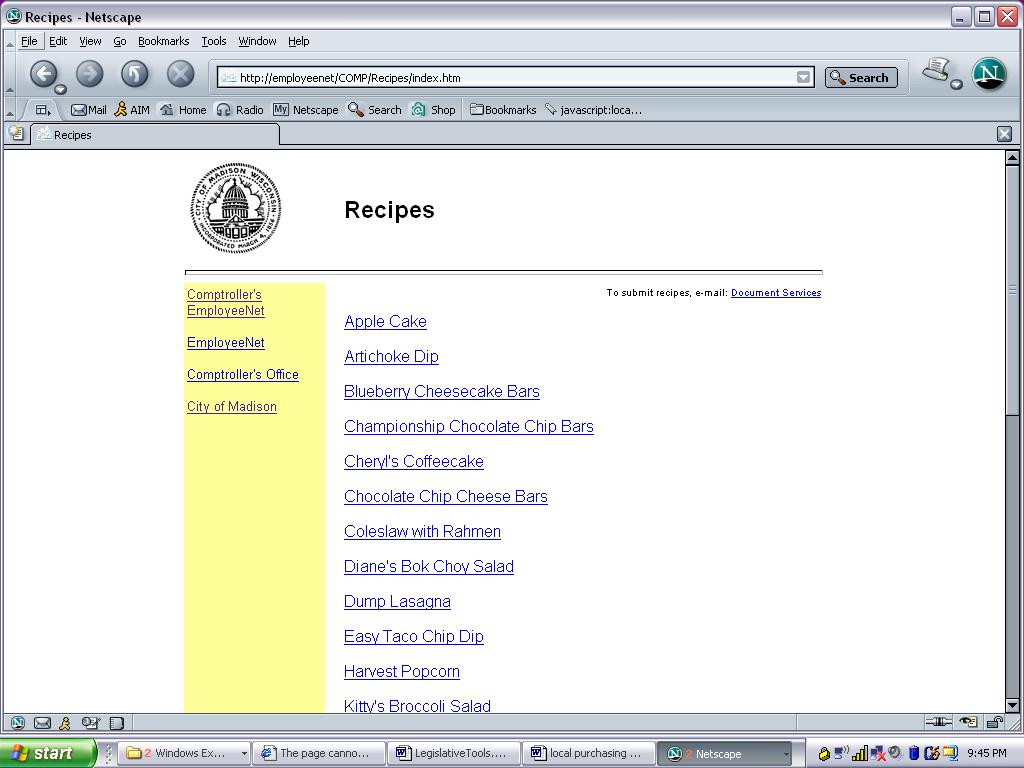
Here's the recipes that every city employee apparently needs:
Apple Cake
Artichoke Dip
Blueberry Cheesecake Bars
Championship Chocolate Chip Bars
Cheryl's Coffeecake
Chocolate Chip Cheese Bars
Coleslaw with Rahmen
Diane's Bok Choy Salad
Dump Lasagna
Easy Taco Chip Dip
Harvest Popcorn
Kitty's Broccoli Salad
Kitty's Mousse Cake
Korean Salad
No-Fuss Party Potatoes
Petite Caramel Pecan Rolls
Raspberry Delight
Sausage or Ham and Egg Brunch
Shrimp Dip
Simple Saucy Potatoes
Quaker Oats Mix
Yankee Pot Roast Read more!
Screwing up on Allied Drive?
No, I'm not talking about the residents who live there, I'm talking about the City of Madison. So, we're probably going to bid at the auction for the "Hauk Properties". (It still needs council approval.) That is likely a very responsible decision given the alternatives. I feel comfortable with that decision. Problem is, what if we end up with the properties, then what?
The City and private property owners have a pretty long history of taking a low-income area, doing wholesale evictions for any infraction, enticing people to move with relatively low "incentives", creating housing that people who previously lived there can't afford or rehabbing the properties, moving people around until they get too frustrated to stay and then if they are persistent, making tenants re-apply to live in their old apartments and then denying them based on strict screening criteria. Essentially, destroying the sense of community that exists and the support networks of the people who live there.
My memory starts with the Vera Court project . . . and stings most over the Broadway-Simpson area with the Waunona Woods one-time affordable condos that the city poured money into. Now doctors live on the lake and former residents received up to $100,000 or more in profits after living in the housing less than 5 years . . . all because of the City's affordable housing efforts.
So, how are we going to handle Allied Drive? That still remains a mystery.
Homeownership vs Rental/Level of Affordability
Everyone seems to agree we need some level of homeownership in order to get more stability in the neighborhood - I'm not sure that is the only way to obtain stability - but it is one way. The bigger questions are:
a. What percentage of housing will be homeownership and what percentage will remain rental?
b. Will any of the homeownership opportunities be affordable to the people who currently live in the rentals on Allied Drive? Or will new people have to move to Allied Drive to replace the displaced renters? (Or will the City just define the "Allied Drive area" as a much larger area to give the appearance of serving people in the "area"?)
c. Will the rentals being torn down (a large amount of three bedrooms) be replaced with similar bedroom sized rental units? Or will they be replaced with one and two bedrooms so we reduce the size and number of families that can live on Allied Drive, displacing more residents? (And if we do that, what is the point of investing in the infrastructure for Boys and Girls Club and other programs for youth?)
The staff and Alder Golden assure us that the answers to these questions will come this summer after a design charette they are doing with the residents in July. I agree, we need to get input from residents. However, that gives little comfort to many of us on all ends of the political spectrum. Some believe we should buy the properties and just tear them all down immediately cuz there is crime!! Others, like me, believe we need a solid plan so we don't just do what we've done to the other low-income neighborhoods.
Management Plan
So, what will that management plan look like? If we buy the properties, what happens to the people who live in those units right now? Will those residents remain in the neighborhood? How long will we hold and manage the properties? What kind of repairs will we need to make and what will that cost? Will we be seeking new tenants to fill the vacancies or non-renewing and letting people go as their leases expire? Who will manage the properties, the CDA or a private company that we hire? Where will the operating costs come from to keep these properties? etc. etc. etc.
While there are many questions, one thing is clear: We have a tremendous opportunity before us. But also a tremendous opportunity to screw this up. Let's hope we get it right this time and not, once again, rearrange the placement of one of our "pockets of poverty" within the City of Madison. Read more!
The City and private property owners have a pretty long history of taking a low-income area, doing wholesale evictions for any infraction, enticing people to move with relatively low "incentives", creating housing that people who previously lived there can't afford or rehabbing the properties, moving people around until they get too frustrated to stay and then if they are persistent, making tenants re-apply to live in their old apartments and then denying them based on strict screening criteria. Essentially, destroying the sense of community that exists and the support networks of the people who live there.
My memory starts with the Vera Court project . . . and stings most over the Broadway-Simpson area with the Waunona Woods one-time affordable condos that the city poured money into. Now doctors live on the lake and former residents received up to $100,000 or more in profits after living in the housing less than 5 years . . . all because of the City's affordable housing efforts.
So, how are we going to handle Allied Drive? That still remains a mystery.
Homeownership vs Rental/Level of Affordability
Everyone seems to agree we need some level of homeownership in order to get more stability in the neighborhood - I'm not sure that is the only way to obtain stability - but it is one way. The bigger questions are:
a. What percentage of housing will be homeownership and what percentage will remain rental?
b. Will any of the homeownership opportunities be affordable to the people who currently live in the rentals on Allied Drive? Or will new people have to move to Allied Drive to replace the displaced renters? (Or will the City just define the "Allied Drive area" as a much larger area to give the appearance of serving people in the "area"?)
c. Will the rentals being torn down (a large amount of three bedrooms) be replaced with similar bedroom sized rental units? Or will they be replaced with one and two bedrooms so we reduce the size and number of families that can live on Allied Drive, displacing more residents? (And if we do that, what is the point of investing in the infrastructure for Boys and Girls Club and other programs for youth?)
The staff and Alder Golden assure us that the answers to these questions will come this summer after a design charette they are doing with the residents in July. I agree, we need to get input from residents. However, that gives little comfort to many of us on all ends of the political spectrum. Some believe we should buy the properties and just tear them all down immediately cuz there is crime!! Others, like me, believe we need a solid plan so we don't just do what we've done to the other low-income neighborhoods.
Management Plan
So, what will that management plan look like? If we buy the properties, what happens to the people who live in those units right now? Will those residents remain in the neighborhood? How long will we hold and manage the properties? What kind of repairs will we need to make and what will that cost? Will we be seeking new tenants to fill the vacancies or non-renewing and letting people go as their leases expire? Who will manage the properties, the CDA or a private company that we hire? Where will the operating costs come from to keep these properties? etc. etc. etc.
While there are many questions, one thing is clear: We have a tremendous opportunity before us. But also a tremendous opportunity to screw this up. Let's hope we get it right this time and not, once again, rearrange the placement of one of our "pockets of poverty" within the City of Madison. Read more!
Tuesday, March 14, 2006
Fingerprinted to Live in City of Madison Public Housing
This afternoon, a man came in to the Tenant Resource Center/Social Justice Center with a letter he wanted to show me. He wanted to know how to get on the City Council agenda because he was really mad and was telling me how messed up the City was. (No, not cuz we're anti-business.) I finally got him to tell me why he was so upset. He handed me a letter from the Community Development Authority (CDA) where he had been granted an informal hearing regarding the denial of his public housing application.
I tried to figure out what was going on. The letter said:
So, I followed up with my staff person who was primarily involved with this individual. The initial denial letter specifically mentioned disorderly conduct and that it was information "received from WI Circuit Court Accesss". Now, the early 90's charges resulted in a no contest plea to disorderly conduct, but that was over 10 years old and our local ordinances prohibit landlords from looking at anything over two years old. Even the dismissed charges were filed in 2003. Our ordinances read:
Does this sound right?
Ok - Nevermind if its right, or legal, or not . . . if you were in that situation what written evidence would you bring to this hearing? What would you do if you were told the only way you could get housing was to be fingerprinted for the FBI? Read more!
I tried to figure out what was going on. The letter said:
Your application was denied for negative behavior, illegal drug activity or criminal behaviors based on information we received from your arrest and/or conviction records. Therefore, you will need to bring written evidence that the information CDA obtained from these sources is inaccurate. It maybe [sic] necessary to have fingerprints taken by the Madison Police Department, in order to confirm with the FBI that indeed a mistake was made in your identity, regarding your arrest and/or conviction records.So, I CCAP'ed the guy (don't worry, it didn't hurt!). Sure enough, there were some charges from 90 and 92 and then nothing until 2003. However, in 2003, the unlawful use of a telephone charges were dismissed.
So, I followed up with my staff person who was primarily involved with this individual. The initial denial letter specifically mentioned disorderly conduct and that it was information "received from WI Circuit Court Accesss". Now, the early 90's charges resulted in a no contest plea to disorderly conduct, but that was over 10 years old and our local ordinances prohibit landlords from looking at anything over two years old. Even the dismissed charges were filed in 2003. Our ordinances read:
Time Limits on Exclusions . The exclusion for certain convictions shall not apply if more than two (2) years have elapsed since the applicant or member of the tenant’s or applicant’s household was placed on probation, paroled, released from incarceration or paid a fine for offenses set forth in Paragraph 1. unless the offense is one which must be reported under the Sex Offender Reporting Requirement of Sec. 973.048, Wis. Stats.In talking with my staff person, I learned that she had been told by CDA staff that even if the disorderly conduct charges are dismissed, they still consider this proof of behavior and deny people anyways. I also learned that she has another client in the same situation. A dismissed disorderly conduct charge that is preventing this person from getting CDA housing.
Does this sound right?
Ok - Nevermind if its right, or legal, or not . . . if you were in that situation what written evidence would you bring to this hearing? What would you do if you were told the only way you could get housing was to be fingerprinted for the FBI? Read more!
Sunday, March 12, 2006
Missing information . . .
Lesson #7: Counter fears and bad information with facts.
So, I thought I would try to look at some more facts about inclusionary zoning . . . I was looking for a data source that I could use. I decided to look at the applications/letters of intent of recent developments that we approved to try to find some hard numbers to show to what extent we "make developers whole". After all, the application/letter of intent requires the developers to provide information about "the sale or rental price range for dwelling units" and it should be a good source of data, right?
However, I noticed something funny . . . . . . apparently we've been accepting incomplete applications - something I probably should have noticed before now. The information I was looking for is routinely left off the letter of intent. Funny thing is, the letter of intent required alot of additional information and most of that appears to be present . . . but no information about the sales and rental prices of the units . . . . hmmmmmmm . . . .I wonder why . . . . Read more!
So, I thought I would try to look at some more facts about inclusionary zoning . . . I was looking for a data source that I could use. I decided to look at the applications/letters of intent of recent developments that we approved to try to find some hard numbers to show to what extent we "make developers whole". After all, the application/letter of intent requires the developers to provide information about "the sale or rental price range for dwelling units" and it should be a good source of data, right?
However, I noticed something funny . . . . . . apparently we've been accepting incomplete applications - something I probably should have noticed before now. The information I was looking for is routinely left off the letter of intent. Funny thing is, the letter of intent required alot of additional information and most of that appears to be present . . . but no information about the sales and rental prices of the units . . . . hmmmmmmm . . . .I wonder why . . . . Read more!
Friday, March 10, 2006
The Rest of David Rusk's lessons . .. .
Zach left out a few of David Rusk's lessons . . . #7 is the one Madison ought to focus on . . . cuz the amount of mis-information out there is staggering . . .
Lesson #1: Enact a mandatory, not voluntary, IZ law.
Lesson #2: Advocate IZ primarily as meeting workforce housing needs rather than advancing social justice.
Lesson #3: However, advocate firmly (if more quietly) that IZ must serve the full range of workforce housing needs.
Lesson #5: Use other public subsidies to achieve deeper affordability.
Lesson #6: Focus on getting an area’s first IZ law adopted.
Lesson #7: Counter fears and bad information with facts.
Lesson #9: Fight for Statewide IZ laws
I suggest you read the full document for yourself. But, in case you don't, here's some other highlights . . .
Rusk notes what he considers an IZ ordinance and what might be called IZ but he doesn't count . . . i.e. things we should probably avoid doing in Madison . . .
Read more!
Lesson #1: Enact a mandatory, not voluntary, IZ law.
Lesson #2: Advocate IZ primarily as meeting workforce housing needs rather than advancing social justice.
Lesson #3: However, advocate firmly (if more quietly) that IZ must serve the full range of workforce housing needs.
Lesson #5: Use other public subsidies to achieve deeper affordability.
Lesson #6: Focus on getting an area’s first IZ law adopted.
Lesson #7: Counter fears and bad information with facts.
Lesson #9: Fight for Statewide IZ laws
I suggest you read the full document for yourself. But, in case you don't, here's some other highlights . . .
Rusk notes what he considers an IZ ordinance and what might be called IZ but he doesn't count . . . i.e. things we should probably avoid doing in Madison . . .
Where are we? From studies by others, such as Non-Profit Housing Association of Northern California and BPI, I’ve compiled a master list of IZ communities. The criteria for getting on my list are pretty exacting:He reminds us to keep our eyes on the prize . . .
1) the IZ law must be mandatory, not voluntary;
2) it must cover all residential construction above a certain minimum project size, or “trigger point;” and
3) it must be jurisdiction-wide (not just targeted on certain areas).
On my list are 134 cities, towns, and counties with 13.2 million residents in Census 2000. That means that almost five percent of our country’s population now lives in communities that mandate mixed-income housing as a part of new housing developments.
My list is undoubtedly an undercount.
• I don’t cover Massachusetts adequately due to insufficient data about many towns’ inclusionary housing policies;
• I haven’t caught up with events in Illinois where the legislature enacted the Affordable Housing Planning and Appeals Act of 2003 – an extraordinary achievement for the housing advocates, led by BPI. The Act requires every one
of Illinois’ 2,824 counties, cities, and townships to have at least 10 percent affordable housing. An increasing number of local governments are adopting IZ laws to meet that goal;
• I refuse to list anything in New Jersey as long as Regional Contribution Agreements (RCAs) are in effect. RCAs were authorized by the state legislature to allow wealthy suburbs to sell back up to half of their “fair share” affordable housing quota to poor cities, thus escaping their court-ordered constitutional duty under the Mt. Laurel doctrine; and
• I haven’t listed New York City where a community coalition of thirty organizations has been successfully pressuring the city council to set aside 20-30 percent for affordable housing in recent major upzonings on a case-by-case basis.
What could IZ achieve? I have simulated “what-if” scenarios for the USA’s 100 largest metropolitan areas. What if mandatory IZ laws had been in effect throughout these metro areas for the past twenty years? I assumed a 15 percent set-aside (the most common standard) and a trigger point of ten or more units (the most common provision) that would cover about 80 percent of all new construction.And finally, he reminds us . . .
Between 1980 and 2000, 21.8 million new housing units were built in these 100 metro areas. IZ would have yielded 2.6 million inclusionary units – almost twice as many affordable homes as were built utilizing Low Income Housing Tax Credits (that HUD says help finance 90 percent of all affordable housing built). That would have met about 40 percent of the affordable housing need, according to the National Housing Conference.
Furthermore, suppose all these communities implemented Montgomery County’s policy of having its public housing authority buy or rent one-third of the inclusionary units to extend the assistance to very low-and extremely-low income families (less than 50 percent and less than 30 percent of Area Median Income, respectively). This would have reducedlevels of economic segregation in these 100 metro areas by 37 percent.
Housing policy is school policy.The lesson here . . . When someone is teaching you a lesson . . . maybe you should pay attention to the whole story . . . not just the parts that suit your politicial point of view . . . there is much more to learn from Rusk . . .
Read more!
Thursday, March 9, 2006
Elections Committee conspiracy theory explained to Alder Palm
Larry, there is no conspiracy . . .
The Elections Committee item I introduced is EXACTLY THE SAME as the one Alder MacCubbin worked on a year ago. I asked Mike to sponsor cuz we had talked about it earlier, I asked Tim to sponsor it cuz it was his constituent who brought the issue to our attention and worked on the language a year or two ago. Brian added his name while I was turned around in my seat talking to Tim and Austin added his name from the floor . . .
freaking relax . . .
and the only reason it got reintroduced is because it went nowhere last time, the mayor's office offered to work on it, to form a workgroup with alders and interested parties . . . and that never happened, so when I was perturbed about the polling place for ward 40, which was already not in the 2nd district, is being moved a few blocks further away from the district . . . and the fact that the clerk didn't even seem to know which alder represented that area because their office had Alder King as a sponsor instead of myself . . . it reminded me that we hadn't moved forward at all on some of the many issues . . . so I reintroduced.
Larry, you can co-sponsor if you'd like, just call Tammy in the clerks office, no one is stopping you - this isn't a partisan thing, no matter how you try to spin it. Why so suspicious all the time? Read more!
The Elections Committee item I introduced is EXACTLY THE SAME as the one Alder MacCubbin worked on a year ago. I asked Mike to sponsor cuz we had talked about it earlier, I asked Tim to sponsor it cuz it was his constituent who brought the issue to our attention and worked on the language a year or two ago. Brian added his name while I was turned around in my seat talking to Tim and Austin added his name from the floor . . .
freaking relax . . .
and the only reason it got reintroduced is because it went nowhere last time, the mayor's office offered to work on it, to form a workgroup with alders and interested parties . . . and that never happened, so when I was perturbed about the polling place for ward 40, which was already not in the 2nd district, is being moved a few blocks further away from the district . . . and the fact that the clerk didn't even seem to know which alder represented that area because their office had Alder King as a sponsor instead of myself . . . it reminded me that we hadn't moved forward at all on some of the many issues . . . so I reintroduced.
Larry, you can co-sponsor if you'd like, just call Tammy in the clerks office, no one is stopping you - this isn't a partisan thing, no matter how you try to spin it. Why so suspicious all the time? Read more!
Wednesday, March 8, 2006
No wonder people are cynical . . .
So, I got the following message from someone this evening . . .
The proposal to have the city sell the land underneath Lincoln School was defeated by the Parks Commission unanimously this evening, despite support from the Mayor, the alder, both neighborhood associations, DMI and both Madison newspapers, plus ULI offered to stipulate that the city could buy back the land for the acquisition price plus CPI adjustments in the event of a catastrophic loss of the building.I'll talk to . . . tomorrow so . . . can report the details. A classic Madison evening.
Sigh . . . what does it take?
Read more!
Saturday, March 4, 2006
The last few days perspectives on paid sick leave . . .
A few sick leave stories from the past few days . . .
MY GROCERY SHOPPING EXPERIENCE
I went to the grocery store Wednesday night after a neighborhood meeting to pick up a few things. I got all my groceries and went to the check out. As I was checking out, the clerk sneezed, and she covered her face with her hand when she sneezed . . . then picked up my groceries and kept running them through the scanner and grabbed the receipt and handed it to me. Now, I'm not a germophobe to the extent that one of my co-workers is (tee hee, you know who you are!) but, I was a little concerned that someone who was sick was handling my groceries and handing me my receipt after she just sneezed on her hand.
Then . . . as the bagger is finishing bagging my grocery, another worker comes up and says to her, "why don't you go home, hope you feel better."
And I left the grocery store with a strong desire to wear rubber gloves as I was putting away my groceries and wipe them down with some sanitizer . . .
EVICTION PREVENTION
So, Friday, I was talking to one of my co-workers and sharing with her how much money we had raised for the Housing Crisis Fund. We were pleased with the generous response from the community and remarking how a relatively small amount of money to many of us can sometimes mean the difference between a bad landlord reference or eviction and a clean tenant record.
My employee was telling me about a person who came in and needed assistance. The person was talking about all of her housing issues and the employee kept trying to figure out what had happened to have this employed person fall behind on their rent. Turns out, she needed less than $100 because she had to stay home from work due to illness. That was the amount she made in those few days that she had to miss work. My employee was remarking that the paid sick leave ordinance really would have made a difference to this person. We then lamented that with all the statistics that we gather, we don't count how many people need eviction prevention are due to a few missed days of work due to illness.
A ROOMMATES DILEMNA
I was talking to a friend who had helped cover their roommates rent last month and wasn't in a position to do it again. Their roommate was really sick and as my friend put it "obviously shouldn't be going to work", but only had a few dollars and couldn't make the rent. So the roommate went to work anyways. This person was going to be serving food to people all evening.
For every story of alleged "beer flu" there are stories like the ones above. I heard/experienced three of them in three days . . . no doubt the paid sick leave ordinance would effect people's lives every day, not just the ones who are sick . . . but those who are likely to become sick as a result of sick people coming to work. Read more!
MY GROCERY SHOPPING EXPERIENCE
I went to the grocery store Wednesday night after a neighborhood meeting to pick up a few things. I got all my groceries and went to the check out. As I was checking out, the clerk sneezed, and she covered her face with her hand when she sneezed . . . then picked up my groceries and kept running them through the scanner and grabbed the receipt and handed it to me. Now, I'm not a germophobe to the extent that one of my co-workers is (tee hee, you know who you are!) but, I was a little concerned that someone who was sick was handling my groceries and handing me my receipt after she just sneezed on her hand.
Then . . . as the bagger is finishing bagging my grocery, another worker comes up and says to her, "why don't you go home, hope you feel better."
And I left the grocery store with a strong desire to wear rubber gloves as I was putting away my groceries and wipe them down with some sanitizer . . .
EVICTION PREVENTION
So, Friday, I was talking to one of my co-workers and sharing with her how much money we had raised for the Housing Crisis Fund. We were pleased with the generous response from the community and remarking how a relatively small amount of money to many of us can sometimes mean the difference between a bad landlord reference or eviction and a clean tenant record.
My employee was telling me about a person who came in and needed assistance. The person was talking about all of her housing issues and the employee kept trying to figure out what had happened to have this employed person fall behind on their rent. Turns out, she needed less than $100 because she had to stay home from work due to illness. That was the amount she made in those few days that she had to miss work. My employee was remarking that the paid sick leave ordinance really would have made a difference to this person. We then lamented that with all the statistics that we gather, we don't count how many people need eviction prevention are due to a few missed days of work due to illness.
A ROOMMATES DILEMNA
I was talking to a friend who had helped cover their roommates rent last month and wasn't in a position to do it again. Their roommate was really sick and as my friend put it "obviously shouldn't be going to work", but only had a few dollars and couldn't make the rent. So the roommate went to work anyways. This person was going to be serving food to people all evening.
For every story of alleged "beer flu" there are stories like the ones above. I heard/experienced three of them in three days . . . no doubt the paid sick leave ordinance would effect people's lives every day, not just the ones who are sick . . . but those who are likely to become sick as a result of sick people coming to work. Read more!
Stop the Slogans!
During the smoking debate it was "Ban the Ban" and "Save Madison Jobs" - and various members of the council were Nazi's and a long list of other things I probably shouldn't repeat.
Now, during sick leave it's "Stop the Mandates!" And we're still Nazi's and a long list of other things I probably shouldn't repeat.
While these gimmicky slogans are cute and all, communicating with elected officials and committee members through slogans is completely ineffective. And if it isn't obvious, calling us names is doubly ineffective.
Now I'm not naive enough to think that these folks actually want to affect change. In fact, I believe the not so clever slogans and radio ads that they paid PR firms to produce are nothing more than an appeal to get people riled up and generate new members for their various organizations.
However, there may be a few people out there who actually want to affect policy, instead of just claiming they want to affect policy. Here's a few tips if you want to be effective:
a. Know what the ordinance actually says.
b. Don't trust your lobbying group to give you accurate information, you'll be sadly disappointed.
c. Offer concrete examples of how the ordinance effects you.
d. Offer suggestions on how the ordinance could be changed.
During the 4 hour long paid sick leave hearing in front of the Economic Development Commission one advocate took detailed notes. The advocate had the highlighter ready to highlight all suggestions that came from the business community to see if such suggestions would be viable changes to the ordinance. After 4 hours, the highlighter was used exactly 0 times, yup, not once. Not one single suggestion on how to improve or change the ordinance . . . but how many people do you think repeated the slogan "Stop the Mandates!" Not a very effective use of their time! Read more!
Now, during sick leave it's "Stop the Mandates!" And we're still Nazi's and a long list of other things I probably shouldn't repeat.
While these gimmicky slogans are cute and all, communicating with elected officials and committee members through slogans is completely ineffective. And if it isn't obvious, calling us names is doubly ineffective.
Now I'm not naive enough to think that these folks actually want to affect change. In fact, I believe the not so clever slogans and radio ads that they paid PR firms to produce are nothing more than an appeal to get people riled up and generate new members for their various organizations.
However, there may be a few people out there who actually want to affect policy, instead of just claiming they want to affect policy. Here's a few tips if you want to be effective:
a. Know what the ordinance actually says.
b. Don't trust your lobbying group to give you accurate information, you'll be sadly disappointed.
c. Offer concrete examples of how the ordinance effects you.
d. Offer suggestions on how the ordinance could be changed.
During the 4 hour long paid sick leave hearing in front of the Economic Development Commission one advocate took detailed notes. The advocate had the highlighter ready to highlight all suggestions that came from the business community to see if such suggestions would be viable changes to the ordinance. After 4 hours, the highlighter was used exactly 0 times, yup, not once. Not one single suggestion on how to improve or change the ordinance . . . but how many people do you think repeated the slogan "Stop the Mandates!" Not a very effective use of their time! Read more!
Friday, March 3, 2006
"Not a Political Party" Liar!
Remember this . . .
When asked if the group would support a mayoral candidate, or if any of its members were considering running for the job, Allen said the coalition was "not a political party," but dedicated to policy.And now this . . .
"What we're running for is a better city," he said.
The Common Sense Coalition is proud to announce the endorsement of three Dane County Board candidates who we believe share our values, and our vision for Dane county's future.I thought they were dedicated to policy . . . what policy? They formed 9 months ago . . . have you seen any policies they have tried to get adopted? Or anything they've done that has been anything less than a shameless political stunt/press release? Read more!
March lobbying contacts
Hopefully, I can do better tracking this month . . . tho I'm getting tired of guessing if these folks are covered by the law or not . . . I just don't have the info I need to determine if they are being paid to lobby or not . . .
Wednesday, March 1, 2006
Phone calls & e-mails with Tripp Widder, Chris Laurent and Gary Gorman, Gorman & Co re: 800 E Wash TIF (not exempt)
Phone call with Susan Schmitz, Downtown Madison, Inc re 800 E Wash TIF (not exempt)
Phone call from Eric Fleming re 428 N Livingston (not exempt)
Thursday, March 2, 2006
Phone calls and emails with Chris Laurent and Gary Gorman, Gorman & co re: 800 E Wash TIF (not exempt)
Phone call with Susan Schmitz, Downtown Madison Inc, re 800 E Wash TIF (not exempt)
Phone call from Kami Eshraghi, Kimia Lounge re liquor license (exempt, no business before us)
Email with Chad Obright, Ellefson Co re inclusionary zoning (exempt)
Friday, March 3, 2006
Phone call with Chris Laurent, Gorman & Co re: 800 E Washington Ave. TIF (not exempt)
Meeting with Gabe, Madison Community Co-op re: zoning change in ordinance (exempt)
Phone call with Davis Sparer, attorney for Madison Community Co-op re: ordinance zoning change (not exempt)
Read more!
Wednesday, March 1, 2006
Phone calls & e-mails with Tripp Widder, Chris Laurent and Gary Gorman, Gorman & Co re: 800 E Wash TIF (not exempt)
Phone call with Susan Schmitz, Downtown Madison, Inc re 800 E Wash TIF (not exempt)
Phone call from Eric Fleming re 428 N Livingston (not exempt)
Thursday, March 2, 2006
Phone calls and emails with Chris Laurent and Gary Gorman, Gorman & co re: 800 E Wash TIF (not exempt)
Phone call with Susan Schmitz, Downtown Madison Inc, re 800 E Wash TIF (not exempt)
Phone call from Kami Eshraghi, Kimia Lounge re liquor license (exempt, no business before us)
Email with Chad Obright, Ellefson Co re inclusionary zoning (exempt)
Friday, March 3, 2006
Phone call with Chris Laurent, Gorman & Co re: 800 E Washington Ave. TIF (not exempt)
Meeting with Gabe, Madison Community Co-op re: zoning change in ordinance (exempt)
Phone call with Davis Sparer, attorney for Madison Community Co-op re: ordinance zoning change (not exempt)
Read more!
Thursday, March 2, 2006
City, Gorman, Get back to the Table
Based on the number of phone calls and emails I have been receiving, it has become extremely apparent how disappointed the neighbors, the business community and nearly anyone and everyone connected to the East side or the City of Madison is over the demise of the Gorman Project on the 800 block of East Washington. That project held the hope to spur development in the East Washington corridor and be the generator to start the TIF district set up to help economic development and particularly employment in the area. Among other things, it was important to add housing to help the enrollment in the downtown schools, prevent sprawl, etc etc. The failure to reach agreement on the financing of the project has set back economic development in this area for years and seems premature. My thoughts about this project have not changed, we do need to protect city tax dollars, but we need this project. There are enough creative people in the City to make this happen . . . we need Gorman and the City to get back to the table and figure this out.
p.s. In order to get the discussion going, I'm introducing a resolution designed to bring people back to the table, and if all else fails, to allow the entire council vote on this very important project, not just the Board of Estimates. This should be at the Board of Estimates meeting on the 13th of March and come back to the Council on March 21st.
(Additional links will be added tomorrow, when the file is ready in Legistar.)
Read more!
p.s. In order to get the discussion going, I'm introducing a resolution designed to bring people back to the table, and if all else fails, to allow the entire council vote on this very important project, not just the Board of Estimates. This should be at the Board of Estimates meeting on the 13th of March and come back to the Council on March 21st.
(Additional links will be added tomorrow, when the file is ready in Legistar.)
Read more!
Wednesday, March 1, 2006
Creating Other Affordable Housing Programs . . .
So, one of the knocks on Inclusionary Zoning is that there are other ways to create affordable housing, particularly that we should use the existing affordable housing stock and make that affordable. Various versions of how to do have been mentioned, but the general idea is that we should just provide downpayment assistance for homes currently on the market. In fact, just yesterday at the Mayor's IZ work group, Judy Compton brought it up again. I've heard this proposal so many times and in so many different ways, but I haven't seen any details.
How much will this cost? Where will the money come from? How many affordable homes will this create?
My guess is that if someone put together a serious proposal, I'd vote for it if it makes sense. If I put together a proposal, 8 people would automatically vote against it because it is my idea and I'd be labeled a communist or spendthrift.
My other guess is, that there is no serious proposal out there because it doesn't produce anywhere near the 300 units per year that Inclusionary Zoning is capable of and it costs phenomenally much more.
Regardless, I'm listening, if you don't like Inclusionary Zoning, what other programs can we provide to help create affordable housing? And what does it produce and cost?
Here's some examples of what we are already doing (with Federal dollars, i.e. no City tax dollars):
American Dream Downpayment
Cost $74,714
Helped 18 households
Average $4,150 per household
Plus an additional
Cost $250,000
Help 25 people
Average $10,000 per household
Home Buy Program
Cost $100,000
Helped 32 households
Average $3, 125 per household
If it takes $424,714 to help 75 of the people who are closest to homeownership, it would cost us $1,698,856 every year to get 300 households into affordable housing, assuming that about $5,000 is going to be all it takes to get them into housing. How many people in the community are only about $5,000 away from affording a home?
Now, are we done with this distraction, can we get back to fixing the IZ ordinance? Or as the mayor put it, are we done being "cosmic"? Or is there a serious proposal out there? Read more!
How much will this cost? Where will the money come from? How many affordable homes will this create?
My guess is that if someone put together a serious proposal, I'd vote for it if it makes sense. If I put together a proposal, 8 people would automatically vote against it because it is my idea and I'd be labeled a communist or spendthrift.
My other guess is, that there is no serious proposal out there because it doesn't produce anywhere near the 300 units per year that Inclusionary Zoning is capable of and it costs phenomenally much more.
Regardless, I'm listening, if you don't like Inclusionary Zoning, what other programs can we provide to help create affordable housing? And what does it produce and cost?
Here's some examples of what we are already doing (with Federal dollars, i.e. no City tax dollars):
American Dream Downpayment
Cost $74,714
Helped 18 households
Average $4,150 per household
Plus an additional
Cost $250,000
Help 25 people
Average $10,000 per household
Home Buy Program
Cost $100,000
Helped 32 households
Average $3, 125 per household
If it takes $424,714 to help 75 of the people who are closest to homeownership, it would cost us $1,698,856 every year to get 300 households into affordable housing, assuming that about $5,000 is going to be all it takes to get them into housing. How many people in the community are only about $5,000 away from affording a home?
Now, are we done with this distraction, can we get back to fixing the IZ ordinance? Or as the mayor put it, are we done being "cosmic"? Or is there a serious proposal out there? Read more!
Subscribe to:
Posts (Atom)